History
Birmingham Bach Society – 100 years old
Origins go back to October 1919, when the Birmingham Bach Society was established by Bernard Jackson, a Bach enthusiast and musicologist, with a lecture on Bach's life given at the Midland Institute. From these beginnings, the life of the Birmingham Bach Society continued with seasons consisting of lectures on Bach and concerts offering performances of his music for solo instruments or small ensembles, orchestra or choir, which in those days numbered a modest 12 to 16 singers.
Scoll down for more
Birmingham Bach Club
The work of Dr. Bernard Jackson continued until 1927 when the choir ceased operation until 1929 when it was re-established largely through the efforts of the former choir secretary Madame Minadieu as The Birmingham Bach Club and affiliated to The Bach Cantata Club in London. Dr. Allen Blackhall, organist at St. Mary’s Warwick and subsequently Principal of the Birmingham School of Music, was appointed conductor and work continued with varying degrees of success until the war years.

Birmingham Bach Society rehearsing, with Orchestra da Camera and Richard Butt conducting, for a concert in St Paul's Church, Birmingham in October 1967
Birmingham Bach Society
On 30 September 1947, the Birmingham Bach Club was re-established again as the Birmingham Bach Society by Dr. Willis Grant, the organist at Birmingham Cathedral and later Professor of Music at Bristol University. Under Dr. Willis Grant, the choir grew and matured as did the repertoire which included Bach's Mass in B Minor for the first time.
Dr. Willis Grant remained conductor for eleven years, and was followed by Thomas Tunnard for one year. Hamish Preston followed as conductor for five seasons and Dr. Roy Massey for two seasons until September 1966 when Richard Butt was appointed as Conductor and Director of Music, which heralded a completely new era.
During the late sixties, the Choir was consolidated and major changes were made to the administration. Previous debts were paid off and the programming enshrined more choral and orchestral concerts in addition to a capella concerts. Increasing financial support was forthcoming from The Arts Council of Great Britain through the National Federation of Music Societies and West Midland Arts which enabled further expansion. The repertoire, apart from the choral music included recitals given by such artists as Yehudi Menuhin, Paul Tortelier, George Malcolm, Gillian Weir and the English Chamber Orchestra under Raymond Leppard. Richard Butt’s links with the Aldeburgh Festival and the BBC brought in a much higher profile of soloists including Emma Kirkby (patron), James Bowman, John Shirley-Quirk, Mary Wells, Gillian Fisher, Brian Kay (patron), John Carol Case, John Mark Ainsley, Charles Brett, Paul Esswood, Martyn Hill, Neil Mackie (patron), Jane Manning, Felicity Palmer, Alfreda Hodgson and many others. These included Peter Pears who honoured the Society by becoming a Patron and in 1971, the Choir was asked to sing at the Aldeburgh Festival.
Links also developed with Leipzig and Bach’s own Church of St. Thomas’s were he was cantor for 27 years. The Choir was invited to give a performance of Bach’s Mass in B minor there on 1 June 1989 with the Leipzig Radio Orchestra. This was one of the great crowning achievements in the life of the Choir.

Richard Butt
Conductor of the Birmingham Bach Society 1966-1992
Under Richard Butt, the Birmingham Bach Society Orchestra was formed with its first appearance being in the performance of Bach’s St. Matthew Passion given in Birmingham Cathedral on 3 April 1976, led by Emanual Hurwitz. Shortly afterwards, Christopher Hirons was appointed leader and brought with him much experience through his work with the Northern Sinfonia, the Academy of Ancient Music, the English String Orchestra and the Academy of St. Martin in-the-Fields. For many years the Birmingham Bach Society programming included orchestral concerts with the Orchestra which were very popular and successful.
The overall repertoire included regular performances of Bach’s St. Matthew Passion, St. John Passion, the Mass in B minor, the Magnificat, Cantatas and Motets. A wide range of other Baroque music was performed together with music of earlier times. Twentieth century music was also featured, especially Benjamin Britten, John Joubert, Paul Spicer and Vaughan Williams.
During Richard Butt’s time various commissions were undertaken, in particular from David Lord, Rory Boyle and Paul Spicer’s “Darling of the World” which was given its first performance on 13 December 1986 in Birmingham Cathedral in a concert which included Britten’s St. Nicolas.
Michael Palmer, Archivist
Paul Spicer and the Birmingham Bach Choir - over 30 years together
Paul Spicer took over as Conductor from Richard Butt in 1992, making this the 27th year of the partnership between Paul & the Choir.
The Choir changed its name from the Birmingham Bach Society to the Birmingham Bach Choir shortly after Paul’s arrival. Whilst the Bach and Baroque traditions have continued under Paul, the repertoire has also extended further into twentieth century and contemporary English and European music particularly works by Benjamin Britten, Edward Elgar, Gerald Finzi, Herbert Howells, John Joubert, Frank Martin, Peter Warlock, James MacMillan, Eric Whitacre and others. New works have been commissioned from Aaron Jay Kernis and Eleanor Alberga. During this period the Choir also gave the first performance in the Midlands of JS Bach’s St Mark Passion (in Lichfield Cathedral, 2017).
As a composer Paul has contributed a great deal to the Choir’s contemporary repertoire. Works include The Deciduous Cross and Man, Wretched Man, both commissioned by Nicholas Fisher, and a number of pieces for Christmas commissioned by Choir members or friends of the Choir. His first major choral work, Easter Oratorio was recorded by the Choir with Lichfield Cathedral Choristers and Special Choir and the English Symphony Orchestra in 2005. The choir then commissioned and performed the world premier of his great choral symphony, Unfinished Remembering, at Symphony Hall in 2014, to commemorate the centenary of the start of te Great War. Paul conducted the Choir with a semi-chorus from the Conservatoire, the Orchestra of the Swan, and soloists William Dazeley and Johane Ansell. Spring 2022 the choir performed the premiere of Paul’s moving Sound the Invisible Trumps composed during lockdown in memory of Pauline Round (past choir President and dear friend) and all those who suffered during the pandemic.
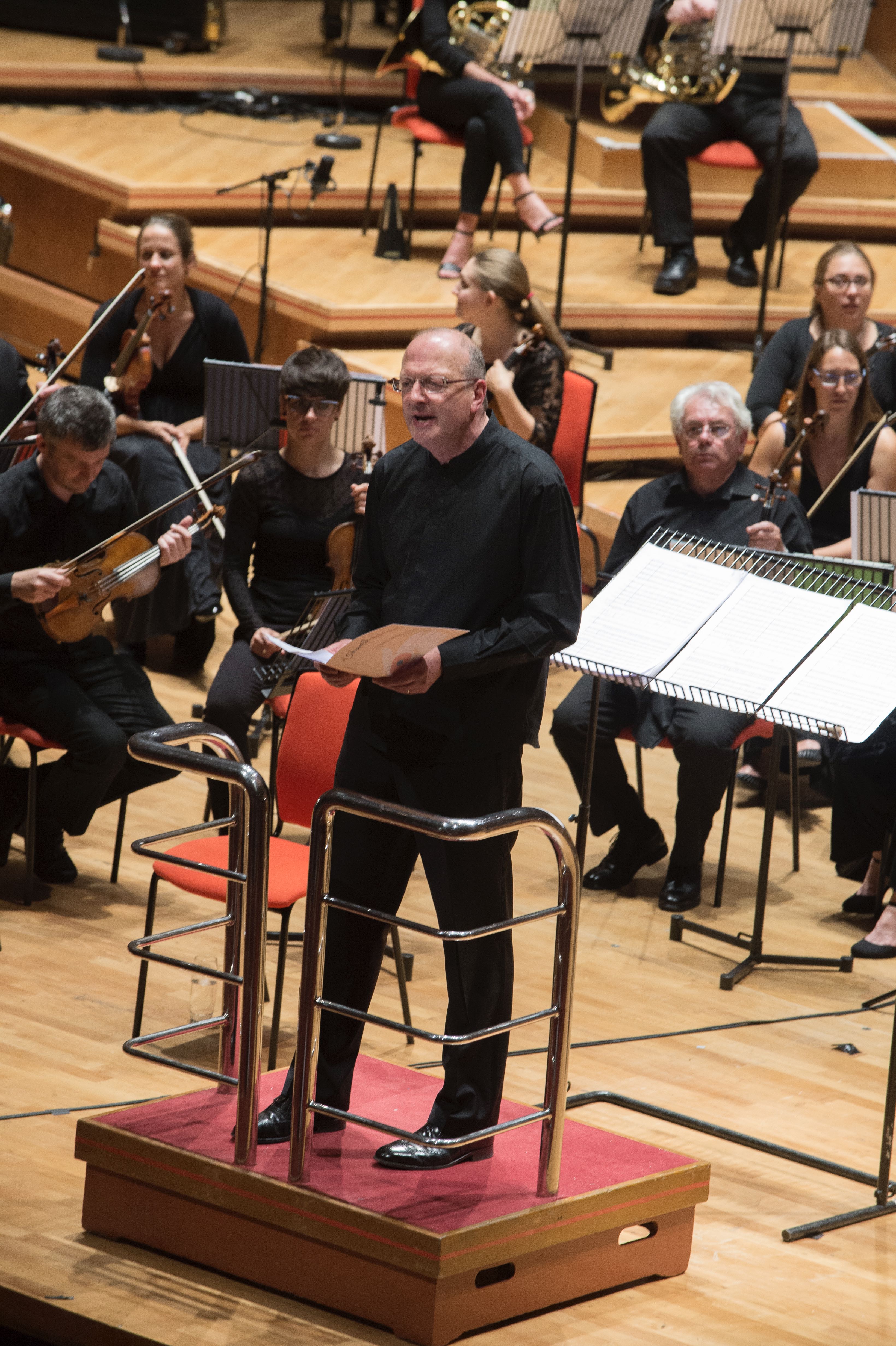
Paul Spicer on thre rostrum, world premiere of his Unfinished Remembering, 2014, Symphony Hall.
Photo Adrian Burrows
In 2017 and again in 2022 the Choir celebrated its enduring partnership with Paul’s directorship marking 25 and 30 years respectively. Both involved with an acclaimed performances of JS Bach's major works.
In its home city of Birmingham The Choir performs around Birmingham in its Cathedrals: St. Chad’s & St Philips, St Paul’s Church (Jewellery Quarter), CBSO Centre, St Albans Church, Highgate, St Francis, Bournville. Other Midlands venues include:, Lichfield Cathedral, Tewkesbury, Evesham & Pershore Abbeys, St Mary’s Warwick and Great Malvern Priory. Its last were to Germany and France.
This year the choir will be performing in St Chad’s Cathedral, Birmingham, Bridgnorth, and Bournville
Throughout Paul’s directorship the Choir has continued to be managed by a Committee drawn from choir members together with Paul and the President.
Chairmen of the Committee since 1992 have been Nicholas Fisher, Jonathan Spencer, Sarah Platt and, currently, Philip Bellshaw.
The Presidents for the same period have been Denis Martineau, Jim Burrows, Pauline Round and, currently, The Rt Hon Gisela Stuart.
For full details of our historical activities since 1930 please visit our archive
Keep in contact


Registered Charity Number: 1194569